How it works
In a nutshell:
Water boils at a lower temperature high on a mountain or when subjected to a vacuum pressure. Water exists in ice, liquid, or steam. Water isn't suitable as a refrigerant gas as it's too inefficient. Other substances are required.
Some substances change temperature according to how much pressure (or vacuum) they're subjected to. These are classified as refrigerant gases. Different substances have different pressure / temperature correlations. Different cooling systems are designed to run with different substances - there is no one size fits all. Some substances occur naturally, other substances are engineered by chemists in a lab. When released into the atmosphere (for various reasons), some substances deplete the ozone layer, others contribute to global warming, others are flammable, and all of them displace oxygen. It is possible to mix most substances to obtain custom operating properties and / or improve energy efficiency.
Water boils at a lower temperature high on a mountain or when subjected to a vacuum pressure. Water exists in ice, liquid, or steam. Water isn't suitable as a refrigerant gas as it's too inefficient. Other substances are required.
Some substances change temperature according to how much pressure (or vacuum) they're subjected to. These are classified as refrigerant gases. Different substances have different pressure / temperature correlations. Different cooling systems are designed to run with different substances - there is no one size fits all. Some substances occur naturally, other substances are engineered by chemists in a lab. When released into the atmosphere (for various reasons), some substances deplete the ozone layer, others contribute to global warming, others are flammable, and all of them displace oxygen. It is possible to mix most substances to obtain custom operating properties and / or improve energy efficiency.
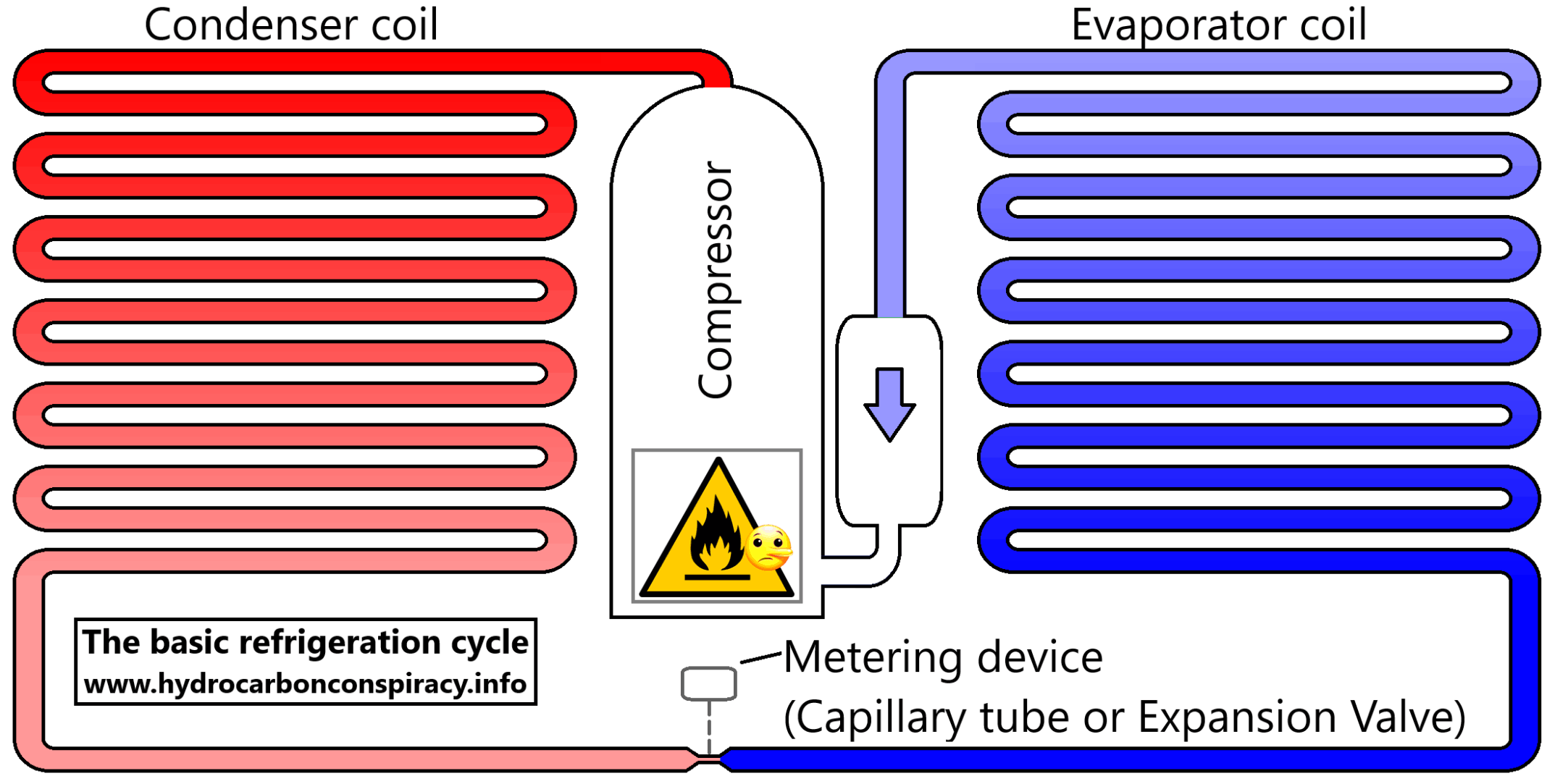
The basic refrigeration cycle
Gas is pumped into the condenser coil and is restricted by the metering device. This restriction banks up the gas in the condenser coil, causing it to heat up, and the gas that does make its way through to the evaporator coil cools down as it discharges. Different gases perform differently, and mixing gases also affects performance. Lower pressure gases (especially hydrocarbon gases) take less energy to compress - resulting in energy savings.
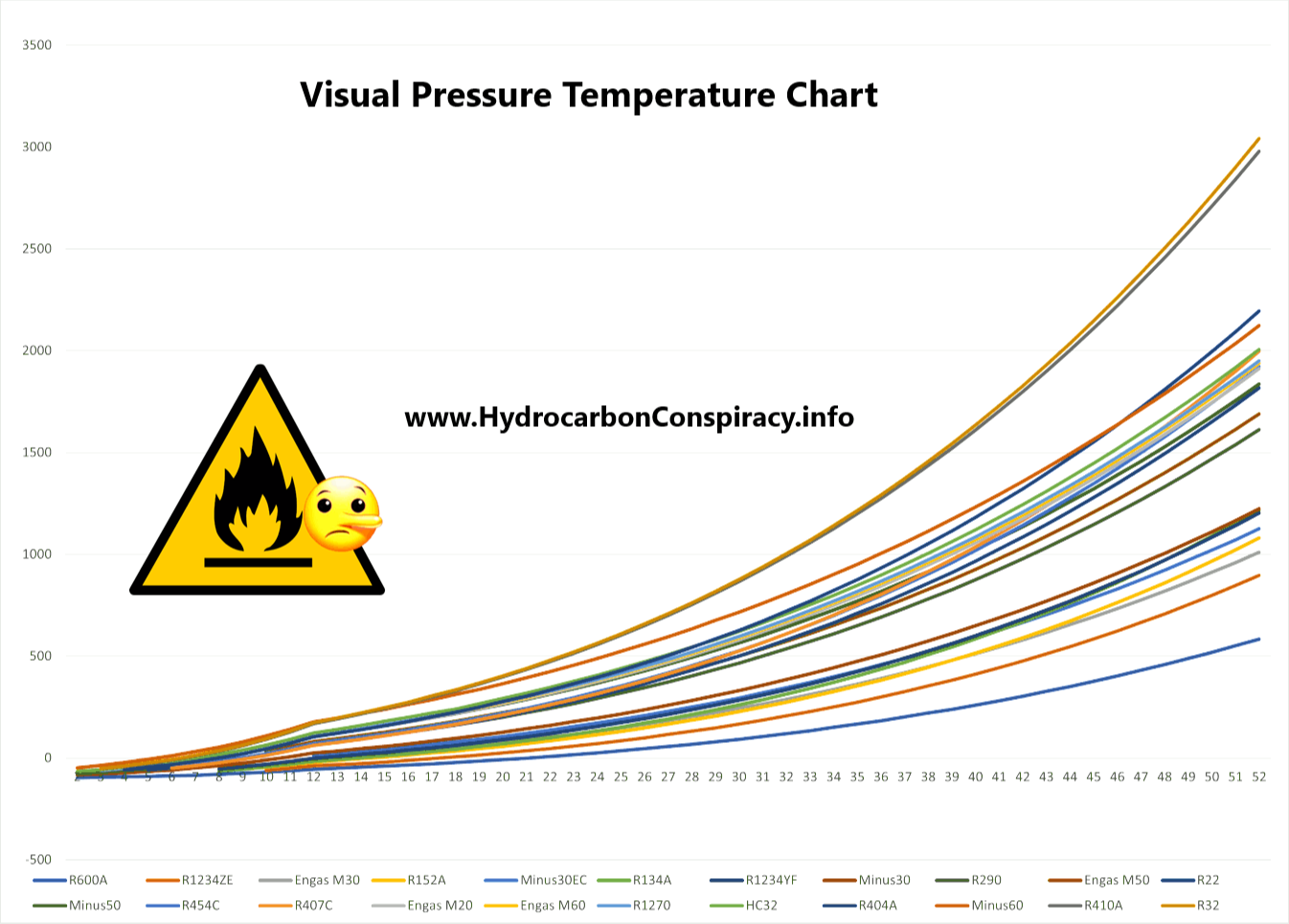
Visual Pressure Temperature Chart
Generated from an Excel Spreadsheet of Pressure Temperature charts.
In further detail:
What I'm about to describe is oversimplified. The rabbit hole goes deep with this one.
A technician will know what I'm talking about.
• R32 is one of the coldest evaporating refrigerant gases.
• Ethane (R170) is a component of Hychill HC32, Minus 50, and Minus 60 - it is much colder than R32, but is unstable at or above 32°C. It is used sparingly.
• Propylene (R1270) is a component of Hychill HC32 and Engas M20. It isn't as cold as R32, but compresses more easily.
• Propane (R290) could be used instead of HC32 or M20, but still needs some R32 to function.
• You can mix these gases to get the best of both worlds.
• A small amount of R600A may be beneficial. It would be subjected to the same condensing pressure as R32, and it would flash at tremendous heat, moving the higher pressure gases along in the refrigeration cycle.
• When the compressor operates, most of the R32 and R170 is on the cold (evaporator) side. Most of the R1270 is subjected to the same compression as R32. Because of the different pressure temperature characteristics, the R1270 yields a higher temperature - propelling most of the gas on to the next part of the refrigeration cycle.
• Different gas blends work best in different climates. In hot parts of Australia, you're best off using a mixture of R32 and R290 (Propane). In cold parts of Australia, you're best off using Hychill Minus 60 (mediocre cooling performance, but awesome heating performance).
Recent tests have resulted in a universal gas blend (A higher proportion of R170 and a similar proportion of R600A + R1270) which increases in efficiency in more extreme temperature conditions. Hopefully this reaches the market soon.
What I'm about to describe is oversimplified. The rabbit hole goes deep with this one.
A technician will know what I'm talking about.
• R32 is one of the coldest evaporating refrigerant gases.
• Ethane (R170) is a component of Hychill HC32, Minus 50, and Minus 60 - it is much colder than R32, but is unstable at or above 32°C. It is used sparingly.
• Propylene (R1270) is a component of Hychill HC32 and Engas M20. It isn't as cold as R32, but compresses more easily.
• Propane (R290) could be used instead of HC32 or M20, but still needs some R32 to function.
• You can mix these gases to get the best of both worlds.
• A small amount of R600A may be beneficial. It would be subjected to the same condensing pressure as R32, and it would flash at tremendous heat, moving the higher pressure gases along in the refrigeration cycle.
• When the compressor operates, most of the R32 and R170 is on the cold (evaporator) side. Most of the R1270 is subjected to the same compression as R32. Because of the different pressure temperature characteristics, the R1270 yields a higher temperature - propelling most of the gas on to the next part of the refrigeration cycle.
• Different gas blends work best in different climates. In hot parts of Australia, you're best off using a mixture of R32 and R290 (Propane). In cold parts of Australia, you're best off using Hychill Minus 60 (mediocre cooling performance, but awesome heating performance).
Recent tests have resulted in a universal gas blend (A higher proportion of R170 and a similar proportion of R600A + R1270) which increases in efficiency in more extreme temperature conditions. Hopefully this reaches the market soon.